









UC Davis Home Page

News and Information

UC Davis experts: Health insurance reform

UC Davis has experts available to talk about the following aspects of the health insurance debate in California and the United States.

Can the U.S. afford universal health care?

Contrary to deeply held American political beliefs, large budgets for social welfare programs, including universal health care, are not a drag on healthy democratic economies, says UC Davis economic historian Peter Lindert. "The tale you hear told by economists and the press is that a large government sector for health care, pensions, welfare, etc., will crush us," Lindert said. "If that were true, Europe would have died a long time ago -- but the welfare state survives quite fine, thank you." In Lindert's 2004 book, "Growing Public: Social Spending and Economic Growth since the Eighteenth Century," he spells out the impacts of big social safety nets on the world's richest democracies. Contact: Peter Lindert, Economics, (530) 752-1983, .

Elements of meaningful reform

Any health insurance reform package must extend health insurance coverage to as many uninsured or underinsured individuals as possible, including undocumented immigrants and people who are too disorganized to maintain and submit financial records, says Dr. Patrick Romano, a professor of general medicine and pediatrics and a researcher with the UC Davis Center for Health Services Research in Primary Care. Meaningful reform should also reduce health disparities, improve physician participation in Medicaid/Medi-Cal (or create a single-payer system) and make health care payment/reimbursement systems more efficient. In California, Romano says, reforms should leverage federal resources to minimize the state's tax burden. Contact: David Ong, UC Davis Health System Public Affairs, (916) 734-9049, .

Undocumented immigrants

Kevin Johnson, the Mabie-Apallas Professor of Public Interest Law and Chicana/o Studies and associate dean for academic affairs at the UC Davis School of Law, argues that legislation based on fear and racism will result in unnecessary and potentially unconstitutional policy. He can provide statistics to support arguments that most illegal immigrants come to the United States seeking work, not free benefits, and that their use of health care services is not a significant drain on the system. Johnson argues as well that while efforts to deny benefits to immigrants tend to be a response to fear of the Hispanic male, Hispanic women are most affected. Johnson is president of the board of directors for Legal Services of Northern California and a member of the board of directors of the Mexican American Legal Defense and Education Fund. His "Immigration Prof Blog" keeps current on immigration issues. Contact: Kevin Johnson, Law, (530) 752-0243, .

Impact of uninsured and under-insured

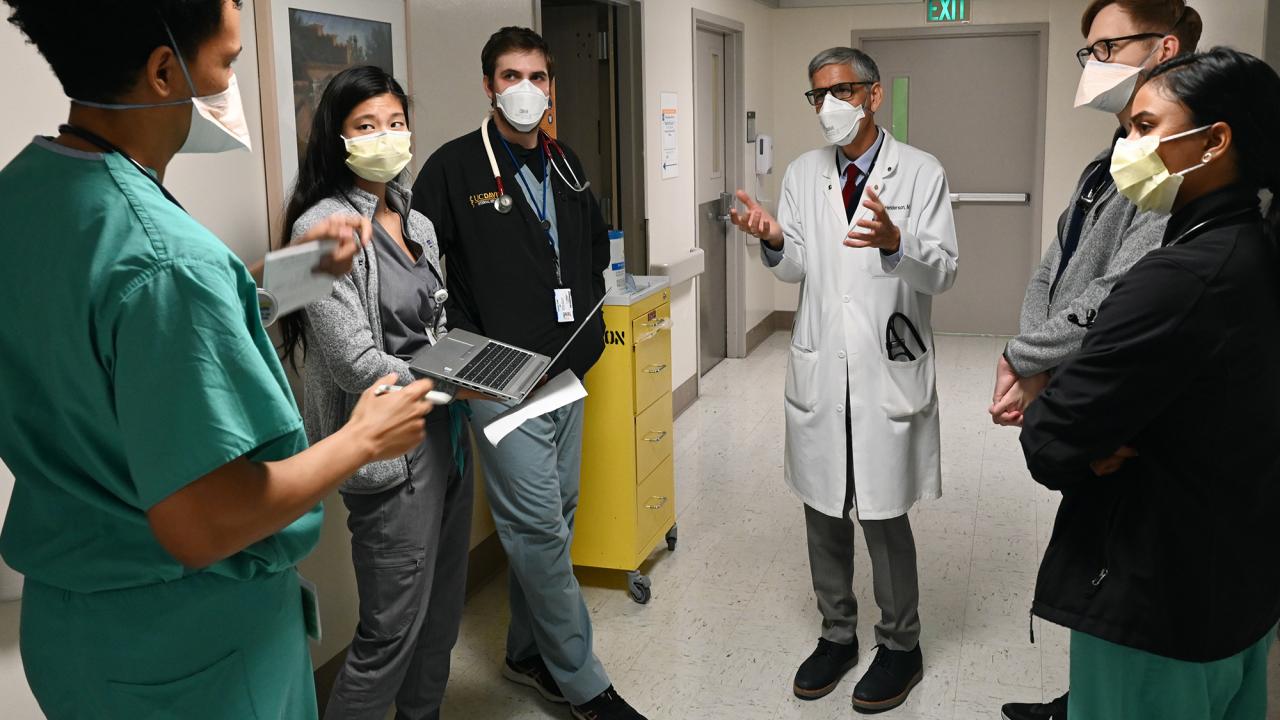
Dr. Allan Siefkin, chief medical officer for UC Davis Medical Center, and Dr. Robert Derlet, a professor of emergency medicine, can discuss the impact of California's uninsured on hospitals and emergency rooms. According to Siefkin, the growing number of uninsured and underinsured in California is saturating hospitals that care disproportionately for the indigent. Siefkin says the frustrated insured have the political clout to demand universal health coverage and true health care reform. Derlet, a nationally recognized expert on emergency department overcrowding, can talk about the impact of the insurance crisis on emergency departments around the country. UC Davis Medical Center, located in Sacramento, is a major teaching hospital and Level I trauma center serving a region of more than 6 million people. Contact: David Ong, UC Davis Health System Public Affairs, (916) 734-9049, .

Public- and private-sector collaboration

UC Davis family and community medicine professor Dr. Thomas Nesbitt can discuss the health care needs of underserved populations and the importance of public- and private- sector collaboration in insuring the uninsured. One of the nation's leading experts on telemedicine and rural health care issues, Nesbitt can also talk about how telemedicine and other technology can be leveraged to increase access to care. Nesbitt directs the UC Davis Center for Health and Technology and serves as executive associate dean for clinical and administrative affairs for the UC Davis Health System. He served two terms on the National Advisory Committee on Rural Health. Contact: David Ong, UC Davis Health System Public Affairs, (916) 734-9049, .


Media contact(s):

  • David Ong, UC Davis Health System Public Affairs, (916) 734-9049, .

  • Jim Sweeney, UC Davis News Service, (530) 752-6101, .

    Top of pageTop of page


    Last updated Jan. 22, 2010